
Hi everyone, I’m Anchi Wu.
During my communications with clients and designers both at home and abroad, a question often comes up: Why does Huadong Playground repeatedly emphasize that we must "strictly comply with relevant safety standards," even when facing personalized client requests that chase ultimate visual impact?
Many friends might think, isn’t a playground just a place to bring joy to children? Why must we use cold "standards" to shackle the imagination of design?
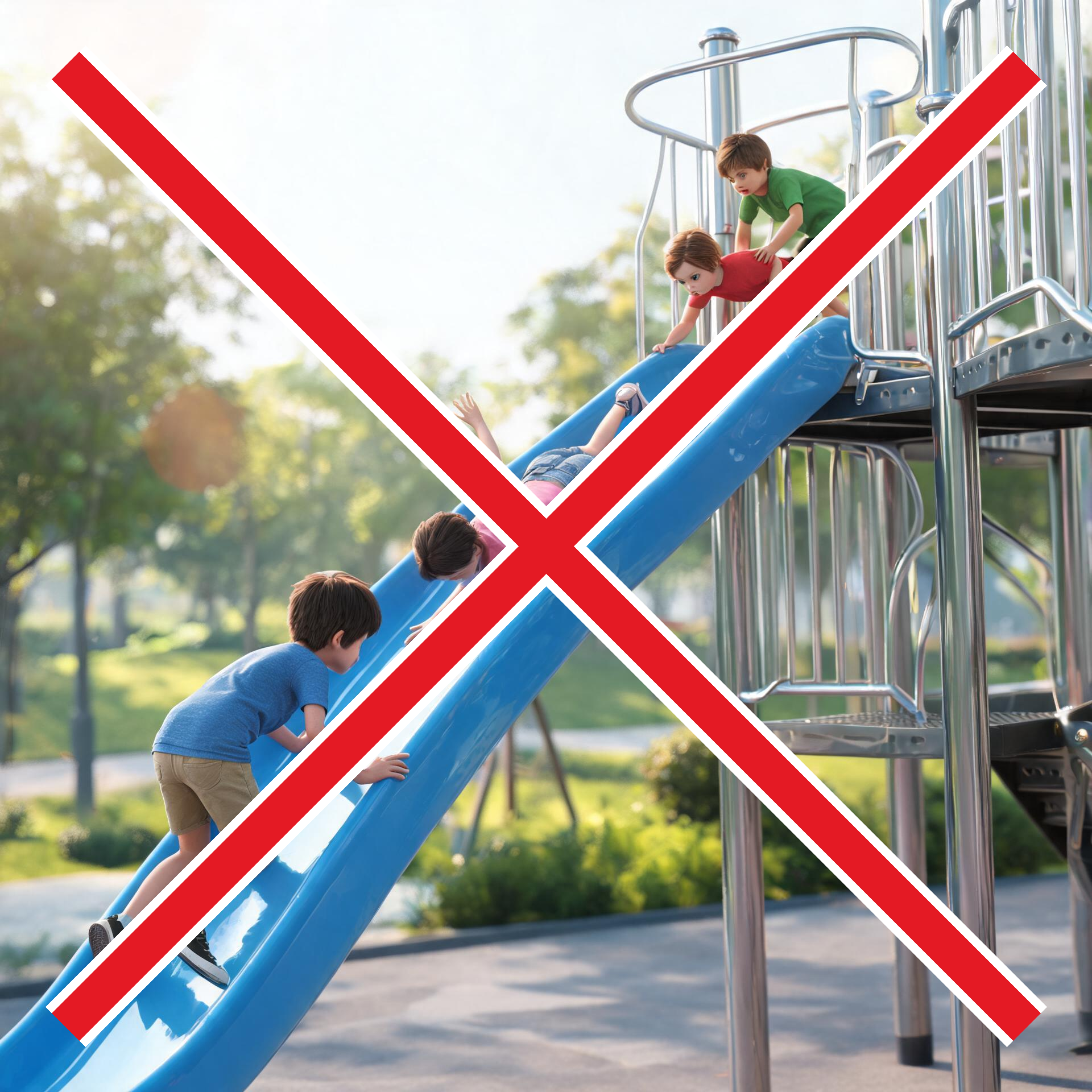
However, as a practitioner with a decade of deep involvement in playground equipment manufacturing—and as a father of three—whenever I see children running and climbing wildly in a playground, what crosses my mind isn't just "how cool this equipment looks," but rather: when children face it, are they truly aware of the potential risks?
Today, combining child development and psychology, I’d like to talk about why we never compromise with "blind thrills."
1. Children's Brains and Curiosity: Born "Fearless Explorers"
From the perspective of brain development, human brain maturation progresses from back to front. Specifically, the prefrontal cortex—responsible for risk assessment, impulse control, and long-term consequence prediction—does not fully mature until a person is in their mid-twenties.
What does this mean?
- Physiological Blind Spot: Between the ages of 3 and 12, children physiologically lack the mature risk-assessment capabilities of adults.
- Driven by Curiosity: They are filled with extreme curiosity about the world. When they see a towering climbing frame, their brain doesn't register "I might fall and get hurt," but rather "What's up there? Can I get to the top?"
Children's curiosity is pure and precious; it is the source of creativity and exploratory desire. However, it is precisely this "fearless ignorance" that dictates they can never become the "gatekeepers" of their own safety.
2. The Psychological Truth: They Aren't Taking Risks, They Crave "Peer Validation"
From the perspective of child psychology, a playground is not just a place to exercise physical fitness, but a micro-society where children establish social status.
- Peer Validation: Children will not stop just because we think a certain height is dangerous. On the contrary, to win cheers from their peers and show off to friends, they will instinctively choose to climb to the highest peak and challenge the steepest slides.
- The Illusion of Idols: In recent years, extreme sports superstars like Alex Honnold, the protagonist of Free Solo, have been admired by many. Some older children may even develop the impulse to push extreme limits.
However, as industrial manufacturers, we must soberly recognize: even if their idols are top extreme athletes, we neither encourage nor allow children to attempt such risks in public playgrounds without professional protection.
During a child's growth, occasionally bumping into harmless bruises is the cost of exploring their physical boundaries and an acceptable imprint of growth; but any serious accident that could lead to lifelong injury is a red line that we, as a manufacturing enterprise, must never cross.
3. Why Are "Standards" the Ultimate Defense Line Protecting Children?
Precisely because children cannot pre-judge risks and possess strong climbing impulses, safety standards (such as the EN 1176 European playground safety standard and Chinese national standards) are exceptionally precious.
Many people think standards are shackles that bind design, but in our eyes, standards are the "bottom lines of life" written through countless predecessors' blood and tears, ergonomic experiments, and rigorous engineering logic:
- Scientific Calculation of Fall Heights: Standards specify the maximum fall height corresponding to different age groups and the required cushioning materials, precisely to catch those children who "blindly charge to the top."
- Strict Prevention of Openings and Gaps: To prevent children's heads and fingers from getting trapped, standards impose millimeter-level restrictions on every gap.
- Limit Testing of Structural Stability: Ensuring that no matter what unexpected, strange postures children use to shake or pull the equipment, the overall structure will not overturn.
When clients propose design requirements that excessively pursue visual impact while ignoring safety standards, the reason we insist on saying "no" or offering professional modifications is because we know better than anyone: design can be boundless and imaginative, but safety must be firmly grounded.
Conclusion
The essence of playground equipment is to use industrial rationality to guard children's emotional happiness.
We advocate that client requirements conform to relevant standards as much as possible—not to save effort, but to ensure that when children recklessly unleash their curiosity and prove themselves to their peers, there is an invisible yet solid safety net behind them, silently catching their bravery.
Allowing children to have thrilling childhood experiences while returning to their parents safe and sound—this is the bottom line Huadong Playground adheres to, and the core soul of all excellent playground design.
Planning a play or fitness space?
Talk to our team about your site, audience and budget. We’ll help you turn the idea into a practical brief.
Start a conversation